Showing posts with label Richard Devereux. Show all posts

Wednesday, 12 August 2026

30th anniversary Isaak and Solomou

 
Isaak and Solomou
 
          11 and 14 August 1996
 
 
Anastasios Isaak,
only twenty-four
and married just a few weeks,
 
snared in the barbed wire
of the Buffer Zone –
the Grey Wolves beat you to death.
 
I watched the film:
Canadian hunters
clubbing a seal pup.
 
A photographer caught
Rauf Denktaş
snapping away with his long lens.
 
Tasos, if only
you had stayed at home.
 
Solomos Solomou,
mad with grief
at your cousin’s death
 
what nerve to climb that flagpole
in front of the Turkish troops,
intent on tearing down
their flag.
 
They were always going to
shoot you dead.
 
You weren’t even
a third of the way up
when the guns pop-popped.
 
In Paralimni they’ve named
a scruffy little Square after you both:
Plateia Isaak kai Solomou.
 
You didn’t even get one each.
It’s the one near the butcher’s shop
where I bought two skinned rabbits.
 
 
                   Richard Devereux

Friday, 29 May 2026

Book launch - Coal and Fire

 
On Monday 29 June 7:30 pm for an 8:00 pm start at the downstairs bar, the Berkeley Square Hotel, Clifton BS8 1HP, Richard Devereux will launch his new Poetic Collection, entitled Coal and Fire.
 

The pamphlet has recently been published by Culture Matters.
 
There will also be short readings by Robin Kidson and Jan Swann and music by Mike Cohen and Chris Speller.
 
For a flavour of the poems:
 
https://www.culturematters.org.uk/cm-publications/books/coal-and-fire-poems-of-labour-memory-and-inheritance/

Sunday, 10 May 2026

Coal and Fire

 
Poems of Labour, Memory and Inheritance
 

This is a new Poetic collection (ISBN: 978-1-918132-04-5, 40pps., £10 inc. p. and p.) of the inspiring Poet Richard Devereux, which I am studying at the moment.
 
In this centenary year of the General Strike, Coal and Fire commemorates that national industrial impasse of 4-12 May 1926 in which Richard Devereux’s grandfathers—one a Rhondda miner, the other a Black Country ‘bobby’—were pitched on opposite sides.
(From the back cover of the book)
 
It is a remarkable and deeply moving collection, a body of work shaped by labour, memory, inheritance, and the enduring dignity of ordinary lives. These Poems carry the weight of lived experience, yet they are written with such grace, humanity, and emotional intelligence that they resonate far beyond the page.
 
Richard Devereux writes with the rare gift of authenticity. His Poetry does not simply describe working lives and inherited histories; it honours them. There is strength in these Poems, but also tenderness; a profound understanding of family, sacrifice, resilience, and the invisible threads that bind generations together.
 
What makes Coal and Fire so compelling is Richard’s extraordinary command of language. His voice is both grounded and lyrical, capable of transforming the familiar into something timeless and unforgettable. Each Poem feels carefully forged, rich with imagery, rhythm, and emotional truth. He has the ability to find beauty in hardship and meaning in memory, illuminating the lives and landscapes that too often go unnoticed.
 
Richard Devereux is, without question, an exceptionally gifted Poet. His work possesses not only technical skill, but genuine heart and moral depth. The Poems in this collection linger in the mind long after reading, because they speak to something universal: our longing to remember, to belong, and to understand where we come from.
 
Coal and Fire is more than a Poetry collection. It is a tribute to endurance, heritage, and the quiet heroism of everyday people. It stands as an inspiring and significant achievement from a Poet of immense sensitivity and insight.
 
Two Poems from the book, one from each part of it, are as follows:


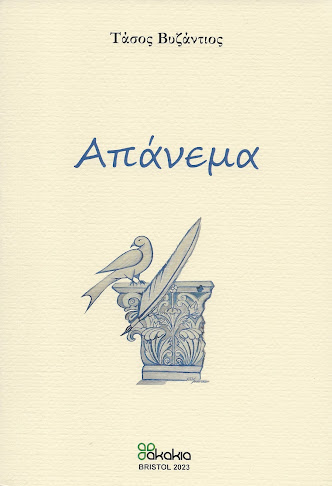
Tasos Vyzantios

Friday, 17 April 2026

Vyronas - The Athens Suburb

 
On 16 April 1924, Henry Morgenthau, President of the Refugees’ Settlement Commission, officially named the new settlement “Vyronas”. It was named in honour of Lord Byron who had died at Missolonghi, in the cause of Greek independence, on 19 April 1824.
 

The new settlement sat 3 kilometres south east of the centre of Athens and spread towards the slopes of Mount Hymettus. In 1920, the population of Athens was 292,000; by 1924 it had jumped to about 450,000 following an influx of refugees from Ionia - what is now the western coast of Turkey.
                       
«Η Ιωνία τίναξε την ανθισμένη ποδιά της και τα λουλούδια πέσανε κάτω από τον Υμηττό» έγραψε ο Μενέλαος Λουντέμης το 1924.
 
"Ionia shook her flowery apron and the flowers fell below Hymettus" wrote the famous Greek writer Menelaos Lountemis in 1924
 
The number of refugees coming to Greece from Ionia continued to increase: the Treaty of Lausanne of January 1923 made provision for a largescale exchange of populations between Greece and Turkey - Christians, coming one way; Muslims, going the other. Estimates of the number of Christians coming to Greece vary between 1.2 million and 1.5 million.
 
The experience of the refugees entering Greece was typically that they would spend several months in refugee camps before being offered the most basic homes on what was, at the time, often uncultivated land or land on which livings had barely been scratched.
 
At least, the refugees could move out of the tents and shacks in which they had been living and had somewhere to start rebuilding their lives and communities. The new homes were built close together; the community built its own school and church.
 
It has often struck me that the architect who designed these simple homes might have been a nine-year old boy with a pencil and ruler. The front elevation of his design was for a small single storey dwelling, with a front door, on either side of which was a small square window. The floor plan would have shown two rooms, one behind each window. As he warmed to the task, the boy went on to design some two storey properties as well, in a like manner, for larger or multi-generational families.
 

The boy architect probably didn’t give much thought to the building materials to be used and may not even have known the word “πλίθα”; in the same way I suspect most English people do not know the English word “adobe”; I didn’t know it until I wrote this article! It means a “mud brick”.
 
The attraction of the πλίθα was that it was cheap and quick to manufacture. It required:
 
Ø clay-rich earth (the binding material)
Ø sand (to prevent cracking)
Ø straw (fibres that strengthen the brick)
Ø water (to form the paste)
 
It was dried in the sun, and did not need to be fired in a kiln.
 
What was necessary, however, was the application of thick coats of plaster to keep the homes water-tight. The few remaining homes of this era have an accordingly ‘lumpy’ appearance.
 
When the new homes were handed over, they were often incomplete - lacking doors and windows. But the refugees were resourceful people and it is easy to imagine the spirit of generosity in which the members of the new community helped one another. These were people who worked hard and rebuilt new lives from almost nothing. I have heard warming stories of wonderful gardens made behind these simple homes; many refugees had brought seeds and shoots of their favourite flowers, trees and herbs from their old homes and these took root here.
 
Athens is now a vast urban sprawl: Vyronas is regarded as an inner-suburb of Athens. It has been a municipality in its own right since 1934. It would be unrecognisable to the earliest residents: almost all the original homes were replaced by concrete “πολυκατοικίες” - “apartment blocks” in the1950s and 60s. They, in turn, are now showing their age.
 
What Vyronas retains is a strong sense of identity, community and historical resonance. Next time you are in Athens, pay it a visit perhaps, wander off the usual tourist track.
 
Richard Devereux

Wednesday, 1 April 2026

MARINELLA

 
What do the late Queen Mother, Sir Cliff Richard and Dame Judi Dench have in common? In Britain, they have acquired the status ‘National Treasure’. This honorary title exists only on the public’s heart and is given to those well-known public figures who are not merely famous, but who have been ‘loved’ by the nation over many years. They represent something truly ‘British’, they ‘belong’ to us, the country would not be quite the same without them.
 

If such a category exists in the hearts of Greeks, then Marinella would be a candidate to be viewed as a ‘National Treasure’. She has recently died; on 28 March at the age of 87 after suffering a stroke on stage at the Odeon of Herodes Atticus 18 months ago.
 
For me, a British philhellene, Marinella meant something quite specific and it is somehow fitting that she has died just a few days before Cyprus National Day on 1 April. Ever since I first heard it, I listen on that day to Marinella singing ‘Voices of the Heroes’:
 
(50) Fones Iroon - YouTube
 
Her passionate interpretation of the verses of the Cypriot poet Klairi Angelidou lasts two and a half minutes – you may need to lower the volume:
 
Άνοιξα την πόρτα κι ήρθε ο ξανθόμαλλος Πέτρος
με τη σημαία και την ρομφαία,
μετρώντας βήματα ζωής και θανάτου.
Κι ήρθε της Γιαλούσας ο Παρασκευάς
κρατώντας στα χέρια την οργή και την οδύνη,
κουβαλώντας τα μυρσίνια της Ανάστασης.
Και παραπέρα ο Κυριάκος
να κρατάει βιβλία σοφίας και να ρωτά «Γιατί;»
κι ούτε που μπόρεσε κανείς από τότε να αποκριθεί.
Μονάχα ο Άγιος Γρηγόρης
φώναξε απ’ τα βουνά της Παναγιάς
«Γρηγορείτε… Ήρθε η ώρα…
Κανείς να μην μείνει πίσω…
Γρηγορείτε… Το Φως απ’ τ’ Αγιοκέρι θα σβήσει
κι αλίμονο στη γη μας,
θα ’ρθει η ανομβρία να κάψει τα σπαρτά της Λευτεριάς
κι ο αγνοούμενος δε θα ’χει σταρένιο ψωμί
κι η μαυροφόρα η Παναγιά δε θα ’χει λάδι στο καντήλι.
Γρηγορείτε… Μάρκο, Λένα, Μούσκο,
του Λιουπετριού αδέλφια,
παιδιά της Ροδαυγής.
Γρηγορείτε Μάνες της Καρπασίας,
Άννα Κυπριανού, Φλωρεντία των Καρύων,
Ελένης της απαντοχής, Μάνα του Καραολή,
ο Άγιος Πρωτόκλειτος σας περιμένει…»
Είπε και χάθηκε το παλληκάρι
και δέρνουν μας οι άνεμοι
και δέρνουν μας οι μπόρες
κι ολονυχτίς μας κουβαλούν τα ξένα καράβια αλυσίδες,
χωρίς αιδώ, χωρίς περίσκεψη.
Αχ, το αίμα έγινε ποτάμι
κι οι αγχόνες στήθηκαν ξανά.
Αγία Γιαλούσα, Αγία Αμμόχωστος
κι εσύ της Λύσης Παναγιάς
αρχίστε της ελπίδας ύμνο τον Χερουβικό.
Πολύ πονέσανε, πολύ τα κορμιά
με τις καταιγίδες της εκδίκησης.
Ο Άγιος Γρηγόρης Αυξεντίου
δέεται και καρτερεί
κι η μάνα του η Παναγιά
κοιτάζει δακρυσμένη τον αντιφωνητή του Νόστου.
 
Κι αυτοί,
όλη τη Δόξα πήραν!
 
Although these words commemorate the struggle of Cyprus for its freedom, Marinella was thoroughly Greek. She was born in Thessaloniki in May 1938 to parents who were refugees from the Pontos. Her family were poor and the family suffered great hardship particularly during the war.
 
At 17 she joined a company of travelling actors; one night the singer fell ill and she took over the role. Soon she was singing in night clubs. The following year, Kyriaki “Kiki” Papadopoulou adopted the name Marinella and met Stelios Kazantzides. They have been described as the greatest male-female duet in the history of Greek popular music. They married in 1964 but divorced two years later.
 
Marinella released 66 studio albums, sang songs by all leading composers, represented Greece in the Eurovision Song Contest and sang at the closing ceremony of the 2004 Olympic Games. But people remember what she didn’t do, almost as much as her many achievements: she refused to sing at the wedding of Aristotle Onassis and Jackie Kennedy because it fell on her day off!
 
Yes, a National Treasure.
 
Richard Devereux

Saturday, 28 February 2026

Orthodox Catechism, 2/3/2026

 
St. Peter and St. Paul Greek Orthodox Church in Bristol invites you to an Online Orthodox Catechism on Monday, 2nd March 2026 at 7:00 pm (English time). This session will feature Richard Devereux speaking on “Saint David – Archbishop and Patron Saint of Wales” and Dr. Harry Harrison presenting his talk on “Great Lent as Preparation for Baptism”. It promises to be an evening of thoughtful teaching, reflection, and discussion.
 

Whether you are new to the Orthodox faith, exploring Christianity, or simply wishing to deepen your understanding, all are warmly welcome. If you would like to attend, please message Fr. Anastasios D. Salapatas to receive the relevant link. We look forward to gathering together online for learning and fellowship.

Tuesday, 20 January 2026

Pilgrimage to the Holy Mountain

 
Mount Athos - The Holy Mountain
 

I am sure most people here will know something about Mount Athos, but first a few quick facts for those who know the least.
 
Mount Athos, the Holy Mountain, is a peninsular in northern Greece, about 130 kilometres east of Thessaloniki. It is about 50 kilometres long and 7 kilometres wide. It is steep-sided, rocky and forested with many types of trees. The peak, in the south, is just over 2,000 metres high.
 
It is part of Greece, but an autonomous region under the direct jurisdiction of the Ecumenical Patriarch of Constantinople. There are 20 Orthodox, monasteries on the peninsular and a number of much smaller communities, called sketes, and kellia, cells, where an individual monk might live an isolated life. Most monasteries are Greek Orthodox but there is also one Russian, one Bulgarian and one Serbian monastery.
 
The oldest monastery, Great Lavra, was founded in 963. All but one of the monasteries was founded between the 10th and 14th century; even the newcomer is over 500 years old. There are many ancient buildings and Byzantine frescoes.
 
In total, today, there are about 2,000 monks. At the beginning of the last century, there were about 7,000. A few years ago, numbers had dropped lower than they are today; but in recent years more young men are choosing the monastic life.
 
There is now a simple network of roads connecting each monastery to its own jetty and making it possible to travel by road between monasteries. Each monastery might typically have its own ‘fleet’ of, maybe, ten vehicles. Most journeys are undertaken on foot. Electricity started to reach Athos in the middle of the last century, though it has never been on the national grid. Monasteries have their own generators and, in the last few years, some are turning to solar power.
 
The Holy Mountain is known as the Garden of the Panagia. No women are allowed to set foot there. The only female presence must remain that of the Panagia. The closest a women can get is by taking a boat tour along the western coast of the peninsular; the boat must keep 100 metres from the shore. Yvonne and I took this boat in the summer of 2023. I had spent two weeks on the Holy Mountain the previous autumn and I wanted her to see where I had been, and where I was going back, for a second visit, that autumn.
 
Most visitors make their own way to the mountain as independent travellers. Before you travel, you must apply for a Διαμονητήριο - a permit, which you collect from an office as you depart for the mountain on the boat from its port at Ouranoupoli. Visitors are allowed to stay for four nights. Visitor numbers to the Holy Mountain are described as having ‘skyrocketed’ in the last two years. Much of this is due to increased numbers coming from eastern Europe. Last year there were some 200,000 visitors. New restrictions have been put in place which will more than halve this number. The monasteries make no charge for accommodation, or for meals they provide.
 
I will say more about the life of a monastery and its monks; in short, a monastery is concerned with prayer. A monk’s day is said to have three elements: 8 hours working for the monastery community - according to his skills and interests: maybe, growing food, working in the kitchen, making small items, such as κομποσχοίνι - prayer ropes, to sell to pilgrims; or studying.  8 hours, at least, in communal or private prayer which leaves up to 8 hours for sleep and eating.
 
What was I doing on Mount Athos?
 
I have travelled to the Holy Mountain twice as a member of a working party organised by the Friends of Mount Athos. There were about thirty of us in the group. When we arrived on the mountain, we divided into smaller groups of about four or five, and stayed in various monasteries.
 
The work we carried out was to clear the footpaths on the mountain to make it easier for other pilgrims, and the Holy Fathers, to move around between the monasteries. This involved cutting down old or dead trees that might have blocked the paths if they had fallen under the weight of winter snow and clearing the vegetation, much of it thorny, that threatened to over-run the paths. We were walking and working six or seven hours a day, except on Feast Days and Sundays.
 
The footpaths on Athos are either footpaths, as we know them in an English woodland, or καλντερίμια, ancient stone footpaths. Occasionally, the work would involve something other than clearing footpaths: I spent a day picking grapes at Hilandar monastery and one day I helped the Father who doubles up as the carpenter at Vatopedi monastery, create an inventory of tools. On two days, when at Vatopedi, the work I did was controversial: let me explain.
 
Friends of Mount Athos was founded in 1990 at the suggestion of King Charles who has visited the Holy Mountain many times over several years.  The Friends describe themselves as: a charity dedicated to the study and promotion of the history, culture, arts, architecture, natural history, and literature of the Orthodox monasteries of Mount Athos.
 
The King’s vision was a simple one: that volunteers would help maintain the mountain using only hand tools. Wildfires are a major concern on Mount Athos, as they are all over Greece.
Athos has its own fire brigade and in several places they have cut the forest to create fire-breaks. Each small working party needs to have a Greek speaker as this may be useful in an emergency. I do not speak good Greek, but I speak a useful amount of it; this was my role on the team. A fireman was planning to open up some very old and badly overgrown καλντερίμια - not as a fire break, but to create points of access to help fight any fire.
 
He needed to have a party to follow behind him and clear away to the side the branches and vegetation that he cut down. Αβράμ, was going to be using an industrial scale strimmer, with a heavy battery on his back.
 
The controversy was this: my team was going to be helping Αβράμ in his work - using a power tool. Was this contrary to the King’s vision of using hand-tools only. Was the King going to be displeased when we got home and heard about this? The management was worried; as it turned out, the King was OK about it.
 
As I have said, most pilgrims are allowed to stay on Mount Athos for four nights. On both of my visits, because we were working to benefit the community of monasteries, I was able to stay for a fortnight each time. This made a huge difference to me: the first few days I was there, I was in a state of mild shock - everything, but everything, was so different to what I had experienced previously.
 
After a few days, I adjusted to the new normal: everywhere, monks in black gowns, many with spectacular beards; I was aware I was in the presence of deeply spiritual people - the Fathers and pilgrims; I was spending two or three hours a day hearing the liturgy - beautiful and strange sounds in utterly beautiful, but mainly dark, καθολικόν - a monastery’s main church or chapel; meals -two a day- taken in the communal dining room, the τράπεζα, in silence, with a Father reading from scripture - wonderful simple vegetarian food; sleeping in dormitories. In one monastery, the shower was a hosepipe attached to the cold-water tap, there being no hot water tap. So different to what I was used to.
 
The first monastery I stayed at was Hilandar. This is the Serbian monastery; most of the Fathers and most of the pilgrims were Serbian. The liturgy was conducted in Church Slavonic. I heard hardly any English or Greek. The typical Serbian pilgrim, stays for one night, venerates the important icons and relics, and leaves the following day. I stayed in a dormitory for a couple of nights - before we got an upgrade - with forty Serbians, typically middle-aged men, several in military camouflage clothing.
 
Usually, my group of four or five had a small dormitory to ourselves. It was certainly a cramped space, as we also had to store our tools and equipment.
 
Clothing is an interesting topic. It was an important feature of the Friends of Mount Athos that the pilgrims in our party must at all times, and in every way, behave perfectly. We wore nothing but dark clothing, mostly black, our arms were always covered. We never touched our food until the Fathers had started to eat theirs. Whatever hardships we experienced, we never complained, but always expressed our gratitude. The group had built up a reputation for good behaviour over thirty years; we needed to maintain it.
 

Some of my companions would get up at 3:00am and attend the liturgy. I usually got up at 6:00am and attended the last hour of it. Then we would take the first meal of the day. We aimed to be leaving for work by 8:00am We would break for lunch - mostly, the snack we had brought with us, sometimes, the kitchen would send us off with bread, cheese and some fruit; we would work till about three and walk back to where we were staying. Then a shower, and an hour or two’s rest or writing up of our diary, then maybe two hours attending the evening liturgy; followed by the last meal of the day. In the evenings, we might meet up with a Father who would show us around the monastery, or entertain us to mountain tea in his cell; or we would talk among ourselves.
 
We were usually in bed just after 9:00pm. Night sounds were the snoring of our neighbours and, sometimes, the calls of jackals on the mountains.
 
Pilgrimage
 
A pilgrim sets out on a spiritual journey quietly, with solemnity and humility. Otherwise, he is merely a traveller, or even a tourist.
 
A pilgrimage is a purposeful journey. Some undertake a pilgrimage in order to recharge their spiritual batteries; for some, the pilgrimage has an element of penance - they come to make amends for something they have done and to seek forgiveness; others seek a spiritual or physical healing - for themselves or for others.
 
When I travelled to Mount Athos the first time, the first pilgrim I met -at Gatwick airport- was an American from Chicago: he had visited Mount Athos a few years earlier to pray for his mother who had cancer. He kissed the belt of the Panagia in Vatopedi monastery and took home to his mother a cloth that had been blessed before the belt. She was cured. He was returning to give thanks.
 
A pilgrimage has several distinct elements. Throughout the ages, including in pre-Christian times, and in relation to faiths other than Christianity, the pilgrim has been a man of faith. Some may be uncertain in their faith and the purpose of their journey may be to questions it, or test it. There may be some who have no faith, but travel in search of faith. In whatever way, faith is central to a pilgrimage.
 
A pilgrimage is likely to involve some preparation; this may be a matter of spiritual preparation or simply a matter of packing carefully. The first time I went to Mount Athos, I bought a new rucksack - the bright yellow one I took with me when I was sleeping on Greek beaches in the 1970’s no longer seemed appropriate. I packed a good supply of raisins, sultanas and nuts. I was nearly 70, likely to be the old man of the party. I was signing up for some hard physical work, to which I am a stranger, so I walked as fast as I could up the many steep hills of Bristol to get fit, and was glad I had.
 
I have always seen a pilgrimage as involving a journey, often a long and hard journey. My journey to Athos, from leaving home to setting foot on the mountain, took almost two days. At each stage of it, I took some pleasure in the mild hardship it involved:
 
Yvonne gave me a lift to the bus station - I travelled on the Megabus with the youngsters; the Leventis Foundation, which sponsors the cost of flights and accommodation for the Friends of Mount Athos, put us up in an airport hotel; I had just fallen asleep when, at midnight, my room-mate turned up: a loud New Zealander who had just flown in from Auckland; we got up at three for our 6am flight. By the time I arrived at the jetty of Hilandar monastery, I was certainly a weary traveller.
 
As I have said, my own particular experience of life on the Holy Mountain involved some physical discomfort in terms of the very basic accommodation, lack of sleep and hard work. I enjoyed this. I think a level of tiredness, an abundance of fresh air and living a simple life, can help open one up to one’s spiritual dimension.
 
The most important aspect of my time on the Holy Mountain was attending the liturgy, for several hours a day. I am not Orthodox, but I find the Orthodox liturgy very appealing. I appreciate its simplicity and its timelessness. These aspects are particularly present in the monasteries of Mount Athos: the same liturgy, the same words, have been celebrated there for many hundreds of years by monks dressed just as they are today. The chanting in some monasteries is simply beyond words.
 
Because I am not Orthodox, I had to attend the liturgy in the outer narthex of the monasteries - right at the back of the καθολικόν. It was no problem; other pilgrims and some monks, particularly the older ones, chose to stand there in the prayer stalls. Once or twice I almost fell asleep standing up in my stall. The sound of the liturgy and chanting seemed to float through to the narthex. It was a wonderful sound.
 
After the evening meal, I would sometimes go with others to venerate icons or relics in the main body of the church. These are glorious, colourful, rich, historic spaces. It was a privilege to be in them. My own favourite was a small side chapel in Vatopedi monastery, that was higher than it was wide or long; there were about ten stalls, usually occupied by nine monks and me. And, of course, one is always aware that one is in these spaces in the presence of some deeply spiritual men. I found this had some strong, undefinable impact on me.
 
Who are the monks on Mount Athos? They are, of course, men of profound spirituality and commitment to their faith. The come from a range of backgrounds; some are simple, not particularly educated men; some are highly academic or have particular skills, such as icon-painting or bookbinding. Some are deeply impressive, not only for their spirituality, but for their wider qualities.
 
I have a Greek friend who is an academic, a sociologist, who as a young man spent many weeks in the libraries of Athos researching the question: why did monks become monks? He met Father Paisios.
 
I had the impression that some of the Fathers would have had successful careers in the ‘outside world’, if I may call it that, had they not become monks. I think, for example, of an evening my group spent with the Deputy Abbot of Hilandar monastery. He entertained us in a space set aside for receiving visitors. When one arrives in a monastery one is always served, typically, a coffee, a shot of tsipouro and λουκούμι, what we here call Turkish delight.
 
That evening, the coffee cups had golden handles, the tsipouro was highest quality, the λουκούμι - the best I have tasted: with coconut. The Deputy Abbot was an imposing man, he spoke no English, but he spoke Greek. I translated; my group was on its best behaviour. He was a gracious host.
 
Other evenings, in the monasteries of Dionysiou and Grigoriou, we spent with an English monk; both about 60 who had been in the monastery for about 30 years. One had been in a rock band. The other was a bookbinder who showed us ‘behind the scenes’ in the monastery and introduced us to a monk at work in his icon-painting studio. They served us mountain tea.
 
in Vatopedi, an American monk, who used to ride a Harley Davidson as a young man, spent two evenings showing us some of the many items in the monastery’s treasury. Some monasteries have wonderful libraries where, centuries ago, many monks diligently copied, not only the scriptures, but also works by writers of the classical period in Greece. They helped preserve the ancient texts.
 
One evening during the liturgy, I noticed a young, novice monk who seemed to be suffering psychologically, he looked very unhappy. I made a point of finding him after the evening meal. He was from Syria. He seemed to appreciate me speaking to him but said he could not speak to me because he did not have the Abbot’s blessing to do so. Monks essentially say goodbye to their families when the join a monastery; occasionally the Abbot may give a Father a blessing to visit his family or to receive a visit from male members of his family in the monastery. I think there are few who have what it takes to be a monk.
 
A pilgrimage is not to be undertaken lightly. But it certainly has the capacity to be a deeply rewarding experience. One aspect of this is talking to others about it afterwards, so thank you for hearing my account of my Pilgrimage to the Holy Mountain.
 

Winter on Mount Athos
 
When I was on the Holy Mountain, I was constantly aware I was walking in the footsteps, not only of Saints, but of other well-known pilgrims. The ones I thought of in particular were Nikos Kazantzakis and Patrick Leigh Fermor. Kazantzakis visited Athos with the great Greek poet, Angelos Sikelianos, in winter 1914. When I visited Kazantzakis’ Museum in Crete, I bought a copy of the diary he kept at the time. I took it with me to Athos and read relevant parts of it. It was while he was on Athos that he met Αλέξης Ζορμπάς who, at the time, was a monk.
 
Patrick Leigh Fermor was British travel writer who at the age of 19 walked from the Hook of Holland to Constantinople; on the way he visited Mount Athos. He almost died there. I commemorate this in my poem Winter on Athos.
 
At the time I wrote the poem, I was staying at Dionysiou monastery. It was such a friendly place, the monks clearly got on well with each other. I imagined them having a snowball fight in the winter. The following year I met a Dutch pilgrim who had been there a few years earlier and had video a snowball fight - the images are ones he took.
 
 
Winter on Athos
 
 
As Winter opens wide her arms
To embrace and hold the Holy Mountain,
Blizzarding snow impedes and slows
The ascent of the Jesus Prayer to Heaven.
 
The fall is deep. Walls built to keep
Pirates out, now gird and insulate
Against the plunder of pitiless cold
That threatens to snatch the frail and old.
 
A hungry wolf comes warily down
And pads the path to a hermit’s cell.
At night, the shrieks of jackals slice
The muffled banks of steep ravines.
 
Down one of which Leigh Fermor fell,
Not twenty yet. He spoke with Death
But a guardian angel lifted him out
And delivered him to a roaring hearth.
 
Above the pantile roofs, there rose,
In winters past, high wisps of smoke,
Gentle grey against the white,
From fires where fingers splayed for heat.
 
Young tonsured monks and novices,
When a depth has settled, are kids again -
Someone starts a snow-ball fight
And the black robes are soon white-splattered.
 
What they need is a snowman friend:
One grabs a shovel, another a carrot
And a Jack-the-lad dares to hang
A monk’s black veil from the frozen crown.
 
But they don’t have the Abbot’s Blessing.
This spells trouble. He has seen their games;
And decided to turn an indulgent eye,
Sure that God will be smiling too.
 
Richard Devereux

Saturday, 17 January 2026

Ομιλία για το Άγιον Όρος

 
Μέσα στο πλαίσιο των διαδικτυακών Κατηχήσεων, που γίνονται κάθε Δευτέρα βράδυ, θα έχουμε την ωραία ευκαιρία να παρακολουθήσουμε μεθαύριο Δευτέρα 19 Ιανουαρίου τ.έ. μια ενδιαφέρουσα ομιλία (στην Αγγλική) του αγαπητού μας Richard Devereux, ο οποίος είναι Ποιητής, Φιλέλληνας και Νομικός, με θέμα «Προσκύνημα στο Άγιον Όρος».
 

Ο Richard είναι τακτικός προσκυνητής στον Άθωνα και γνωρίζει αρκετά καλά τη ζωή της προσευχής στον ιερό εκείνο τόπο. Έχει μάλιστα γράψει και ωραία Ποιήματα για τη ζωή στο Όρος των καστρομονάστηρων. Είναι βέβαιο πως η ομιλία του θα είναι άκρως εμπνευσμένη και ελκυστική γιατί θα είναι κυρίως βιωματική. Όλοι είναι ευπρόσδεκτοι.

Tuesday, 23 September 2025

Talk on “Philhellenes” (the text)

 
In Boston, Massachusetts, in 1824, a young woman broke a young man’s heart. Samuel Howe had just qualified as a doctor. A romantic spirit, he idolized Lord Byron and perhaps he knew of Byron’s death, in April that year, at Mesolongi. Aged 23, he sailed to Greece, offering his services to the revolution as a surgeon. But once there, he acquired an appetite for fighting and became a military commander.
 

Howe returned to America in 1827. He brought back with him Lord Byron's helmet and many Greek orphans. He raised about $60,000 – a huge sum in those days – to alleviate famine and suffering in Greece. He set up orphanages on Aegina and Andros.
 
Afterwards, Howe wrote an account of the revolt, Historical Sketch of the Greek Revolution, which was published in 1828. He described a ‘philhellene’ as
 
‘A man, generally, a young man, who was ready and eager to give up ease,  custom, money-getting and go overseas to fight a savage enemy among savage mountains, all for the love of freedom and of that dear land which was next in his affections to his own, the land of the imperishable Ideal.’
 
the term ‘philhellene’
 
Samuel Howe’s definition of ‘philhellene’ was the original definition. It is the definition of a soldier who was a philhellene and knew philhellenes. The first recorded use of ‘philhellene’ in English was in 1824. It soon came to include anyone who supported the Greek struggle to overthrow the Ottomans, not only by fighting, but also by raising funds for it or raising awareness of it. It may be useful to call these men ‘the original philhellenes’.
 
Before then, however, the members of the Φιλική Εταιρεία, the Friendly Society, the intellectual and spiritual drivers of the Greek revolution, had adopted the term Φιλέλλην to describe like-minded people.
 
Once Greece was established as an independent nation, the need for the word ‘philhellene’, fell away and the word fell largely into disuse. It received a revival in the 1960’s and came to mean, additionally, ‘a lover of Greece or Greek language, art, culture’. I will call these ‘modern philhellenes’. The term recognises the effort they make in really getting to know, not only the places of the Hellenic world, but also its language, history and culture.
 
In English, we also have the word ‘Hellenophile’ – a lover of Greece, which was first used in 1880. I believe it is right to draw a distinction between a ‘modern philhellene’ and a ‘lover of Greece’. Between φιλέλληνας and ελληνόφιλος. Visitors who go to Greece usually have a great time, they return there and will get to know Greece, without necessarily becoming students of it. They might well say ‘I love Greece’. But this does not make them ‘philhellenes’. Rather, they are ‘lovers of Greece’.
 
I shall concentrate in this talk on ‘the original philhellenes’ and will assume we are all familiar, in general terms, with the Greek Revolution that began in 1821 and resulted in the creation of an independent Greek nation in 1830.
 

the original philhellenes
 
what inspired them?
 
The Age of Enlightenment was a philosophical and intellectual movement across Europe, primarily in the 18th century, which emphasised, among other things, reason, liberty and progress. The American Revolution of 1776 and the French Revolution of 1789 – with its slogan ‘liberté, fraternité, égalité’ – were inspirations for many. If there, why not here, people thought? Supporting the Greeks became a way of signalling one’s disapproval of the status quo in one’s own country. In Germany and Switzerland, for example, the young resented the control of much of Europe by Austria and Russia.
 
In Britain, those who had attended public schools – confusingly, these are the ones you pay to attend – and had studied ancient Greek and ancient history, saw the present struggle of the Greeks as a chance to honour and restore the principles of the democracy of the Golden Age of Athens: Samuel Howe’s ‘imperishable ideal’.
 
In short, the most compelling, romantic and spiritual call was that of Freedom -capital F- Freedom.
 
While others saw the Greek’s struggle in political terms – Democracy versus Tyranny. For some, it was a moral issue: Good versus Bad. For others, their concern was what we would now call ‘a humanitarian crisis’ – a wish to alleviate the suffering of war. At its simplest, it was a David versus Goliath struggle – where we always want ‘the little guy’ to win. The Ottomans had occupied ‘Greece’ for 400 years, their power was weakening: the liberation of these oppressed from this oppressor was an idea whose time had now arrived.
 
Not everyone, of course, was so high-minded. For some, the call was adventure – the prospect of being ‘where it was all happening’, running towards the burning cause of the day in the same way a young man will ‘run a mile to see a fire’; some were simply looking for a fight; others were fleeing their creditors, or the law, or their families, or a broken love, like Samuel Howe, or even themselves. Part of Lord Byron’s decision to sail to Greece was to redeem himself, in his own eyes and the public’s, following a scandal. Among the irregular fighting force, there were, as ever, desperados and chancers. Some knew there was always money to be made in a war and fancied themselves to make it. 
 
And perhaps it is worth saying: for some, an element of their wish to see a new nation of Greece was a desire to see the defeat of Mohammedenism, as Islam was called at the time, and to secure a victory for Christianity.
 
who inspired the original philhellenes?
 
Napoleon Bonaparte died in British custody on the island of Elba on 5 May 1821. It took two months for the news to reach Europe but when it did, it stirred the passions of many young people and intellectuals, especially in France where Louis XVIII was an old and reactionary king. Weeks earlier the Greek Revolution had started. It presented a cause for supporters of libertarian principles.
 
Mark Mazower writes ‘The news of [Napoleon]’s passing was, even more so than Byron’s death three years later, something that unified Europe … it gave the Greek struggle a wider significance.’
 
In 1816, the British government had purchased the Parthenon Marbles from Elgin and placed them in the British Museum. The Venus de Milo was found in 1820 and taken to France. In 1821 it went on display in the Louvre. In 1824 Eugène Delacroix painted a canvas 4 metres high depicting "The Massacre at Chios" where, perhaps, 50,000 Greeks were killed and 45,000 enslaved by the Ottomans. It drew large crowds at a major exhibition, also in the Louvre. Two years later, Delacroix painted "Greece on the Ruins of Missolonghi" showing Greece as a mourning woman. It too caused something of a sensation. Together, these various works of art raised the profile of the Greek struggle among the educated classes of Europe.
 
The most beloved Englishman for Greeks is Lord George Byron. Like his contemporaries Shelley and Goethe, he had written with passion about Greece, taking an idealised view of its past glories. It should not be under-estimated how such works were capable of inspiring young men of a romantic inclination, such as Samuel Howe.
 
Byron had visited Greece in 1809, aged 21. He did not return till he sailed to join the Revolution in 1823. His visit in 1809 developed his admiration for Greek culture, philosophy, and history and was one of the inspirations for his most famous works, Childe Harold’s Pilgrimage, and Don Juan.
 

Don Juan was published in 1821. In Canto 3, Byron acknowledges numerous significant events and individuals in the history and culture of ancient Greece. Here is just one stanza from Canto 3:
 
The mountains look on Marathon—
    And Marathon looks on the sea;
And musing there an hour alone,
    I dream’d that Greece might still be free;
For standing on the Persians’ grave,
I could not deem myself a slave.
 
Byron saw Freedom as a universal right. It is rare for a poet to recognise, as Byron emphatically did, that ‘actions speak louder than words’.
 
When he died, Byron’s body, apart from his heart which the Greeks kept, was returned to England. He was denied a burial in Westminster Abbey on account of his ‘questionable morality’ but huge crowds queued see his body as it lay in state nearby. His death prompted a surge in volunteers heading to fight in Greece and, if the British government had been only half-listening to the Greek cause before, it was listening with both ears now.
 
Napoleon’s death in 1821 had prompted Shelley, in the same year, to write his poem ‘Written on Hearing the News of the Death of Napoleon’ and a verse drama ‘Hellas’ which was the last work he published. His wife, the writer Mary Shelley, the author of Frankenstein, was also a philhellene and, interestingly, in 1824 a Greek publication described her as φιλελληνίδα.
 
who were the original philhellenes?
 
The largest numbers of philhellene volunteers, who actually went and fought in Greece, came from Germany, France and Switzerland. We in Britain like to imagine we were the closest allies of the Greeks but we were not, in terms of the numbers who joined the fight. Significant numbers also came from America and Russia. I have found references to others who came from Finland, Sweden, Poland, Hungary and Italy.
 
There were several points of departure for Greece, many left from Marseille. For the most part, spirited young men, with perhaps some basic military training at school; few had experience of war. Many brought their own weapons and sometimes trouble broke out between them. They caused a headache for the French authorities who were glad to see them set sail. But several of the Italian, German and French philhellenes were veterans of the Napoleonic wars.  Imagine them turning up, wearing their medals on their chests. Imagine the sense of excitement and anticipation on the quay, the bars and coffee shops filling up with volunteers, waiting to embark. The owner of the Café du Parc actually changed its name to Café Ypsilanti.
 
War
 
The first foreign fighters to see action in the Greek revolution took part in the battle of Peta, in Epirus, not far from Arta. This was in July 1822. The Ottomans were 6,000 infantry and 1,000 cavalry; the Greeks, under Mavrokordatos – 2,000 Greeks and 93 philhellenes.
 
The philhellenes must soon have asked themselves ‘What have we let ourselves in for?’ A local warlord, Bakolas, really little more than a klepht or bandit, had done a deal with the Ottomans and withdrew his men from the battle, after it had started, and took to the mountains. The battle turned in the Ottomans’ favour. 68 of the Philhellenes were killed. Mavrokordatos retreated to Mesolongi, his reputation badly damaged.
 
what was the philhellenes’ experience of Greece?
 
The passionate, romantic young men who left to fight for Greece had a shock waiting for them: the Greeks of the day were not the Athenians of the Golden Age of Pericles. As Byron acknowledged, the modern Greek was, in part, the product of the long Ottoman age. For the first philhellenes, their first encounter with actual Greeks was usually a disappointment to them. They found the Greeks hopelessly divided among themselves. Local kapetans, in truth, warlords, hated one another every bit as much as they hated their Ottoman masters. They could not be relied upon. Quite different men to the officer classes of Europe.
 
Petrobey Mavromichalis made an appeal for volunteers to come and fight with his ‘Spartan fighters’. It was widely reported across Europe and those who landed, after many days at sea, in Kalamata to join his forces expected to find a well-drilled army. They found, instead, a band of ill-disciplined Maniots. They found mules and camels – a strange sight for many.
 
The southern Peloponnese of the time has been described as being in a state of anarchy. An attempt to form a regular army, independent of the kapetans, was short-lived. The kapetans resented the idea.  Individual philhellenes were liable to be robbed, or killed, by klepts coming from the mountains. Everywhere there were spies of one faction or another; a foreigner was liable, rightly or not, to be accused of spying and to meet a spy’s death. Most volunteers spoke no Greek and could not talk themselves out of trouble. It led to a feeling of isolation and placed a distance between them and those whose cause they had come to support.
 
They often found themselves short of food, accommodation and supplies. They resorted to stealing. They ran out of money. They became weak. They fell ill with malaria, typhus and the plague. They struggled with the heat. In short, many of them quickly became unhappy.
 

Rivalries arose among the philhellenes themselves; a constant reason was that many expected to have the rank of officer and the status that came with it. Many were disappointed to find themselves in the ranks. Men brought with them to Greece the prejudices and resentments their own nation held for other particular nations of Europe. One philhellene wrote’ We are constantly killing each other on the slightest provocation’.
 
Many too were shocked at the hatred the Greeks felt for the Turks and the resulting behaviour of Greeks towards the Turks, particularly so following the occupation of Corinth. When philhellenes intervened to protect Muslim women and children, they risked their own lives.
 
The conclusion of some enlightened commentators was that the Greek character had been degraded by the years of Ottoman occupation and, once liberated, it would be restored.  As a result, magazines and newspapers that had once embraced the Greek cause, now included accounts by those returning from Greece, disillusioned after their bad experiences there.
 
The French authorities made use of fighters returning unhappy from Greece, to address those gathering in Marseille, waiting to go and fight. Many then decided not to go. The great initial rush of those hurrying to Greece had slowed substantially by the end of 1822. Many foreign fighters, though, remained in Greece for several years, like Samuel Howe, and others continued to arrive, although never at the initial rate. The war with the Ottomans dragged on over the next six years, partly as a result of the failure of the Greeks to gather behind a single, charismatic leader.
 
When it was clear the struggle would be a long one, the emphasis now switched to what could be done in the capitals of Europe to better fund and equip the troops that did remain in Greece, to relieve suffering in Greece, and, crucially, to maintain a high level of support for the Greek cause. This would put pressure on the governments of the Great Powers to ‘sort it all out’. Which is what eventually happened. Once the British and French navies arrived in Navarino Bay in 1827, there was only going to be one outcome. But it must be remembered, the English motive was not so much liberate Greece, but to prevent Russia alone expanding its influence into Greece.
 
financing the Greek struggle
 
A simple view of the position is that the significant sums raised by bank loans or from wealthy donors tended to be spent on military supplies and ships, while monies raised by local Greek Committees was increasingly used to provide humanitarian aid.
 
Byron sold his estate near Manchester and used the proceeds, and some savings, to fund his involvement in the Greek struggle: a fund of £20,000. In today’s terms, he was a multi-millionaire. He raised money across Europe to support the Greek cause. He appealed to European governments and the wealthy donors to donate.
 
Byron had sailed for Greece from Genoa in 1823 and spent the autumn on Kefalonia, in the small village of Metaxata. He paused there and sent emissaries to the various rival Greek leaders, ‘taking the temperature’ of the situation, wondering what he would say if offered the Crown of Greece, and imagining what it would be to fight. He sailed to Mesolongi, arriving there on 5 January 1824 and joined up with the forces of Mavrokordatos. In February he became ill and his health would decline until he died of a fever on 19 April.
 
By the end of March 1824, the "Byron brigade" of 30 philhellene officers and about 200 men had been formed, paid for by Byron. From his £20,000 fund, he spent £4,000 re-equipping the Greek fleet and £6,000 to settle a dispute between the Greek leadership and Suliot fighters who were demanding back-pay. Much of his energy was still being spent trying to reconcile the rival Greek leaders He died without seeing military action.
 
Apart from Lord Byron, which British philhellene made the greatest contribution to the Revolution?
 
First, George Canning, a prominent politician who served as Foreign Secretary during most of the Greek Revolution and as Prime Minister from 1827. In recognition of his support for the Greek Revolution, Canning Square Πλατεία Κάνιγγος in Athens is named after him.
 
Second, Edward Codrington, the commander of the fleet of the Great Powers at the decisive battle of Navarino. His orders were to achieve a peaceful resolution to the situation in Greece: the British government did not want the Ottomans defeated, just that Greece should be allowed more autonomy within in the Ottoman empire. But Codrington, a philhellene, engineered a decisive battle and the defeat of the Ottomans.
 
And third, Frank Hastings, like Codrington – a veteran of the Battle of Trafalgar, who contributed £5,000 pounds for the construction of the Greek Navy’s first warship, the "KARTERIA" – “The Endurance” and was its first captain. With a warship of its own, Greece might start to believe it could become a nation.
 
modern philhellenes
 
Finally, let me say that I am sorry not to have had time to speak of the ‘modern philhellenes’, only of the ‘original philhellenes’. Perhaps another time. As a starting point, I have done something that required little effort: I have simply looked at my bookshelves and noted the names I saw who I regard as modern philhellenes – there are, of course, very many others.
 
artists
Edward Lear and John Craxton
 
writers
Henry Miller, Lawrence Durrell, Peter Levi, Dilys Powell, Victoria Hislop and Bruce Clark
 
poets
Robert Graves, Ruth Padel and Alicia Stallings
 
translators
Kimon Friar, Edmund Keeley, Rae Delven, Rex Warner and Emily Wilson
 
academics
Maurice Bowra, Roderick Beaton and Mark Mazower
 
soldiers
Patrick Leigh Fermor (also, of course, a writer) and Monty Woodhouse
 
diplomats
Michael Llewellyn-Smith and John Kittmer
 
and last, but no means least, Phillip Sherrard (also a translator of Greek poetry) and Metropolitan Kallistos Ware who together prepared the first full English translation of the φιλοκαλία.
 
For me, it is always an honour when a Greek describes me as φιλέλληνας. I am proud to be a philhellene. Had I been 23 in 1824 like Samuel Howe, I wonder, would I have gone to fight for Greece?
 
NOTE:
A Talk of Mr Richard Devereux, Poet - Lawyer and Philhellene, to the Greek Orthodox Church of St. Peter and St. Paul in Bristol, on Sunday 21 September 2025.